
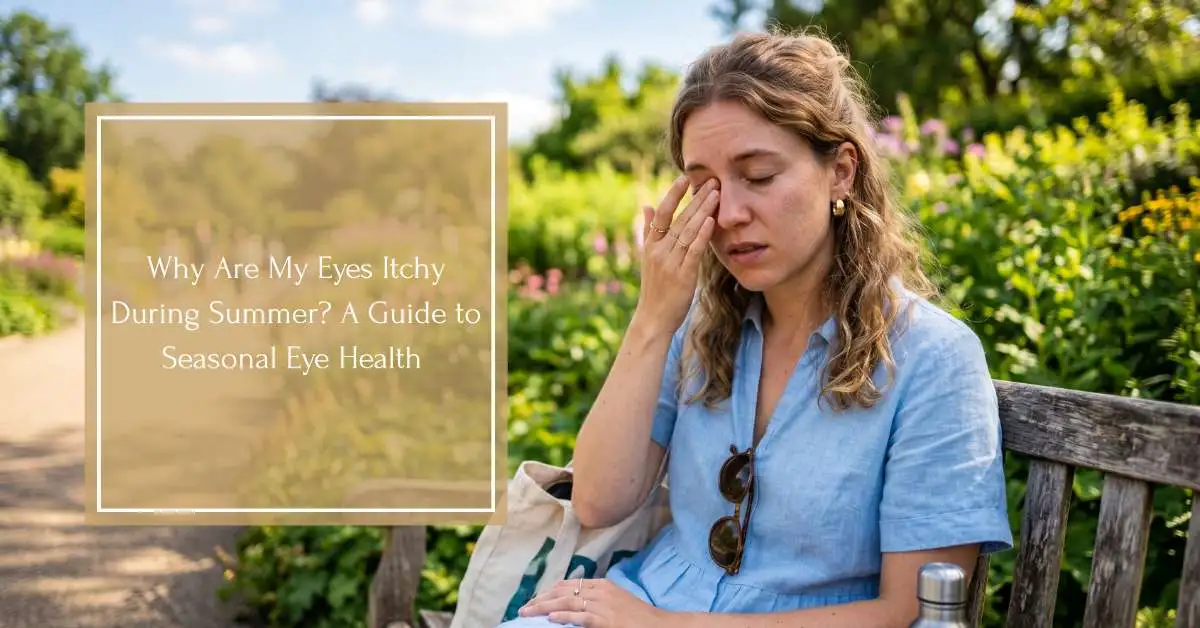
If your eyes start to itch every year as the weather warms up, you are in very good company. Itchy summer eyes are one of the most common reasons people come to see me in the warmer months, and the cause is almost always something harmless that settles with simple measures. Understanding why it happens, and the few signs that mean something more, takes most of the worry out of it and usually makes the itch easier to control.
The usual cause
For most people, itchy eyes in summer are due to seasonal allergic conjunctivitis, sometimes called hay fever eyes. The conjunctiva is the thin, clear skin that covers the white of the eye and lines the inside of the eyelids. When tiny particles such as pollen land on it, the body can treat them as a threat and release a chemical called histamine. Histamine is what makes the eye feel itchy, look red, water, and sometimes swell a little. It is the same process behind a runny nose and sneezing, which is why eye symptoms and hay fever so often arrive together.
Why summer in particular
The timing is really about pollen. Tree pollen tends to peak in spring, grass pollen through early summer, and weed pollen later on, so different people notice their worst weeks at slightly different times. Symptoms are usually worse on warm, dry, windy days, when far more pollen is carried in the air, and they often ease after rain has washed it to the ground. Summer adds a few extra irritations of its own. Bright sun, heat, dusty air, and long spells in air-conditioned offices or cars can all dry the surface of the eye, and a drier eye tends to feel itchier and more sensitive. For many people the real cause is a blend of allergy and dryness rather than one alone.
How to recognise it
Allergic eyes have a fairly typical pattern. The standout feature is itching, often in both eyes, along with redness, watering, a gritty feeling, and slightly puffy lids. Crucially, allergic conjunctivitis is not usually painful, does not normally make the eyes sensitive to light, and does not affect your vision beyond a little temporary blurring from watering. The discharge, if any, is clear and watery rather than thick or coloured. These features are reassuring, because they help separate a harmless allergy from the less common problems that need prompt attention.
Why rubbing makes things worse
When eyes itch, the natural urge is to rub them, and it does bring a moment of relief. Unfortunately rubbing also releases more histamine, so the itch quickly returns stronger than before, and the eyes become redder and puffier. There is a further reason to be careful. Hard, repeated rubbing places real mechanical stress on the cornea, the clear dome at the front of the eye, and over time vigorous rubbing is recognised as a factor that can weaken the corneal shape. Breaking the rubbing habit is one of the single most helpful things you can do, and a cold compress, simply a clean flannel cooled under the tap and held gently over closed eyes, soothes the itch far more safely.
What actually helps
The most effective step is also the simplest, which is reducing contact with pollen. On high pollen days it helps to keep windows closed, to wear wraparound sunglasses outdoors, and to shower and change clothes after being outside so you are not carrying pollen onto your pillow. A little smear of balm around the nostrils can trap pollen before it reaches you.
When these are not enough, eye drops are the mainstay, and it is worth knowing how they differ. Lubricating drops, often called artificial tears, rinse allergens away and ease dryness, and are a sensible first choice. Antihistamine eye drops work quickly to calm itching and redness during a flare. Mast cell stabiliser drops, such as sodium cromoglicate, work differently by preventing the release of histamine in the first place, but they take a few days to build up, so they are best started before your usual season and used regularly. Combined drops that do both are available on prescription. Antihistamine tablets help when the nose and eyes are affected together. Stronger steroid drops are occasionally needed for severe cases, but only under the supervision of an eye specialist, because they require monitoring.
If you wear contact lenses
Contact lenses and allergy season do not always sit comfortably together, because lenses can trap pollen against the eye and worsen the itch. During bad spells it often helps to wear glasses more, to switch to daily disposable lenses if you use reusables, and to avoid putting drops in while lenses are in your eyes unless the drops are designed for that use. If your eye surface is very inflamed, it is wise to pause lens wear until things settle.
When to seek professional help
Allergic conjunctivitis is harmless in the great majority of cases, but a few symptoms should prompt a check rather than self-treatment. Seek advice if you develop genuine eye pain, marked sensitivity to light, any drop in vision, a thick coloured discharge, or symptoms in one eye only that are not settling, or if the itch is severe or keeps returning despite treatment.
References
- National Health Service. Allergic conjunctivitis. London: NHS; 2023. Available at: https://www.nhs.uk/conditions/conjunctivitis/
- Moorfields Eye Hospital NHS Foundation Trust. Allergic conjunctivitis: patient guide. London: Moorfields; 2024. Available at: https://www.moorfields.nhs.uk/ae/patient-guides/allergic-conjunctivitis
- Association of Optometrists. Allergic conjunctivitis: advice for patients. London: AOP; 2024. Available at: https://www.aop.org.uk/advice-and-support/for-patients/eye-conditions/allergic-conjunctivitis
- National Institute for Health and Care Excellence. Clinical Knowledge Summaries: allergic conjunctivitis. London: NICE; 2024. Available at: https://cks.nice.org.uk/topics/conjunctivitis-allergic/
- Leonardi A, Castegnaro A, Valerio ALG, Lazzarini D. Epidemiology of allergic conjunctivitis: clinical appearance and treatment patterns in a population-based study. Current Opinion in Allergy and Clinical Immunology. 2015;15(5):482–488.
- Patient.info. Allergic conjunctivitis. Leeds: Patient (Egton Medical Information Systems); 2025. Available at: https://patient.info/eye-care/eye-problems/allergic-conjunctivitis
