
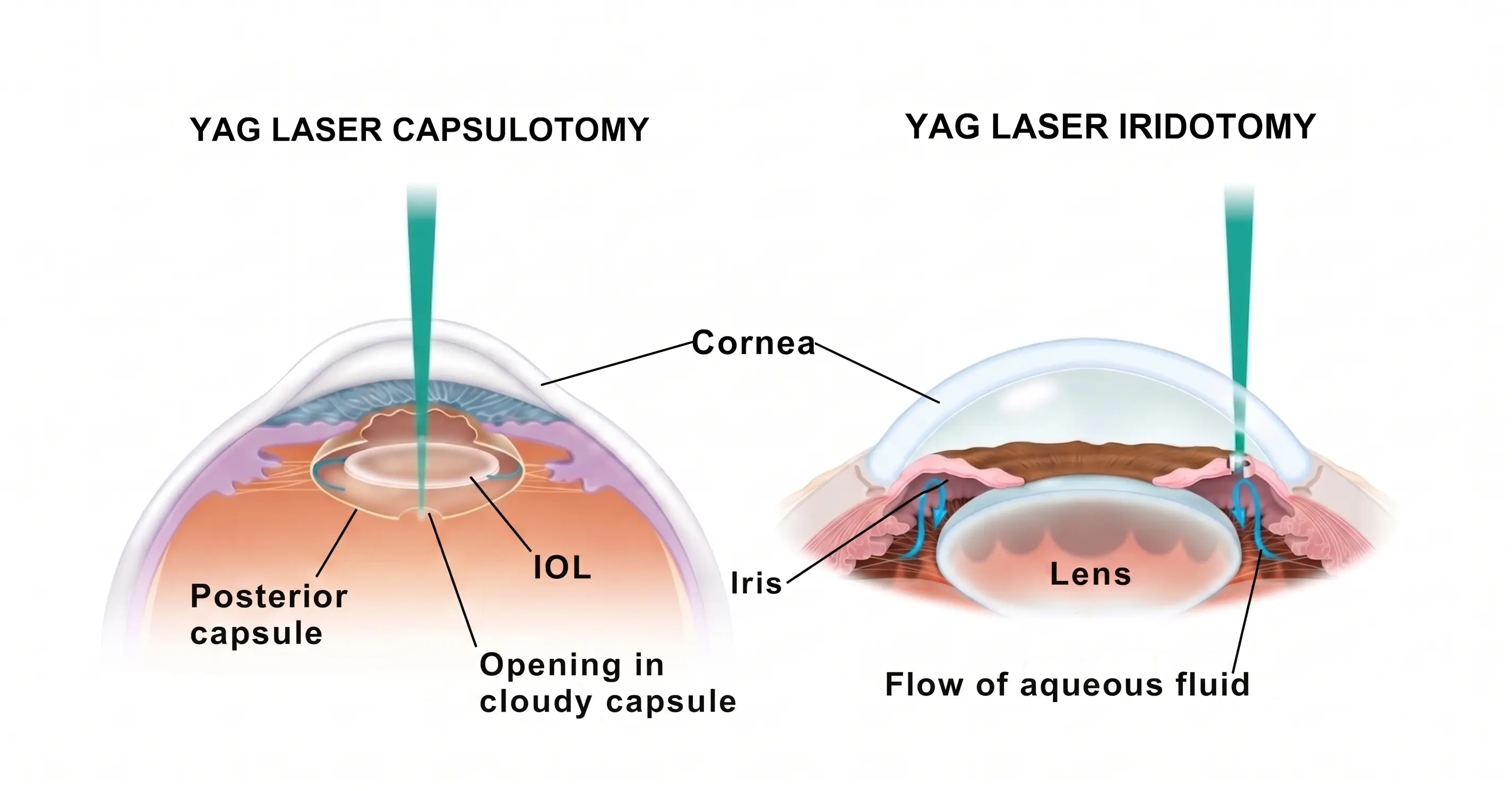
It is common for vision to become slightly blurred or "cloudy" months or even years after successful cataract surgery. This is not the cataract returning, but a natural thickening of the membrane that holds your lens implant in place. This is often called a "secondary cataract" or Posterior Capsule Opacification (PCO).
Mr. Mrinal Rana provides a rapid and effective YAG Laser Capsulotomy service to instantly clear this cloudiness and restore the high-definition vision you experienced immediately after your original surgery.
During cataract surgery, your natural cloudy lens was removed, but the thin, clear "capsule" (the bag) was left behind to hold your new artificial lens. Over time, microscopic cells can grow across the back of this capsule, creating a frosted-window effect.
A YAG Capsulotomy is a painless, "walk-in, walk-out" procedure that takes only a few minutes.
The procedure is performed in the clinic while you are seated at a device similar to the one used during a standard eye exam. You may see a few "floaters" for a day or two afterward as the membrane clears, but you can usually return to your normal activities immediately.
For patients with "narrow angles," there is a risk that the eye’s drainage system could suddenly become blocked, leading to a dangerous spike in eye pressure (Acute Angle-Closure Glaucoma). A YAG Laser Iridotomy (PI) is a preventative treatment designed to safeguard your eye from this sudden emergency.
Mr. Mrinal Rana recommends this procedure for patients whose eye anatomy puts them at high risk of vision loss from pressure spikes.
In some eyes, the iris (the colored part of the eye) sits too close to the drainage channel. This can "trap" fluid behind the iris, causing it to bow forward and block the drain entirely.
Mr. Rana utilizes high-resolution imaging to measure your "drainage angle" to the millimeter. If your angles are dangerously narrow, a Laser Iridotomy is often the safest long-term strategy to prevent a painful, sight-threatening pressure spike in the future.
The procedure is very brief and performed with numbing drops. You may experience slightly blurred vision for an hour or two due to the drops used, but there is no "recovery time" required. It is a highly effective, evidence-based way to ensure your eye pressure remains stable for years to come.
As a specialist in both the cornea and the internal structures of the eye, Mr. Mrinal Rana ensures that every laser treatment is precisely calibrated to your unique anatomy. By using the latest YAG laser technology, he prioritizes both the safety of your retina and the clarity of your vision.
If you have noticed blurring after cataract surgery, or if you have been told you have "narrow angles," request a consultation with Mr. Rana to discuss these simple, protective laser treatments.
