

You reach for lubricating drops. They help a little, or perhaps not at all. You try a different brand. Nothing changes. Eventually, you begin to wonder whether something else is going on.
Often, something is. Persistent watery eyes are rarely a sign that the eye simply needs more moisture. Far more often, they are the eye's way of reacting to an underlying problem that drops alone cannot resolve.
What Watery Eyes Actually Mean
The medical term for excessive tearing is epiphora. It is a symptom, not a diagnosis. It arises from an imbalance between how many tears the eye produces and how efficiently it drains them away.
Under normal circumstances, a small gland produces a steady supply of tears that spread across the eye with each blink. Tears then drain through two tiny openings at the inner corner of each eyelid into a channel called the nasolacrimal duct, which carries fluid into the nose. When this system works well, production and drainage are in balance and there is no overflow.
Watery eyes develop along one of two paths. The first is overproduction: the eye generates more tears than the drainage system can handle, usually as a reflex response to irritation or dryness. The second is under-drainage: tear production is normal, but the drainage channel is blocked or narrowed. Identifying which path is responsible is the essential first step, and that distinction cannot be made from symptoms alone.
Common Causes That Are Often Misunderstood
Dry eye and reflex tearing
Dry eye is the most counterintuitive cause of watery eyes. When the surface is poorly lubricated, the eye responds by producing a flood of reflex tears. These emergency tears lack the correct balance of oils and mucus to form a stable film, so they spill onto the cheek while the surface itself remains poorly protected. Treating this kind of watering with lubricant drops offers only partial relief, and only when the drops are chosen to address the specific weakness in the tear film.
Allergic eye disease
Allergic conjunctivitis produces watery, itchy, red eyes as a direct result of histamine being released when the eye encounters an allergen. The watering typically comes alongside intense itching, redness in both eyes, and a tendency to flare at certain times of year. Seasonal allergic conjunctivitis is a significant cause of watery eyes in spring and summer across the UK, including the wider Warwickshire area. Lubricant drops offer little relief for allergic watery eyes. Antihistamine or mast-cell-stabiliser drops tackle the cause directly and produce considerably better results.
Blocked or narrowed tear ducts
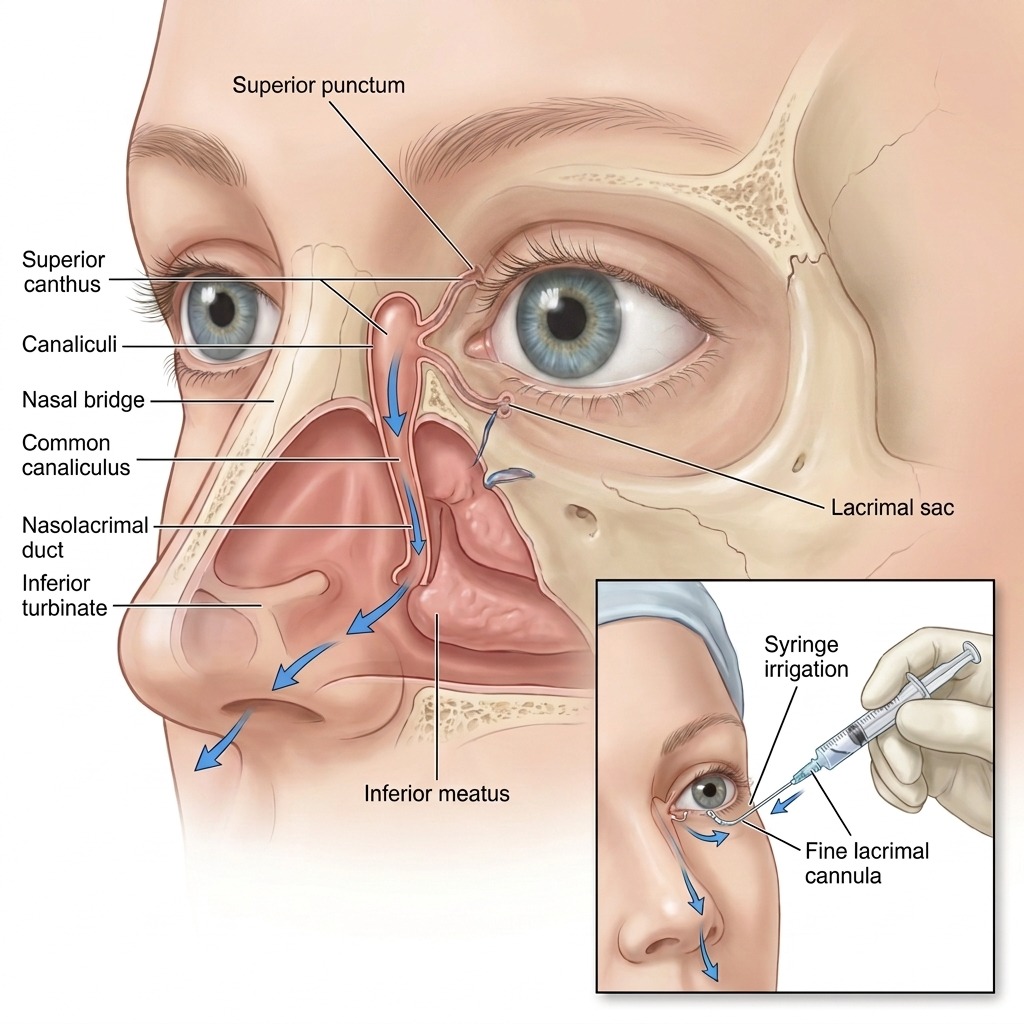
A blockage in the tear-drainage system is one of the most common structural causes of watery eyes, particularly in older adults and young babies. In adults, the duct can narrow through long-term inflammation, age-related changes, or a history of repeated infection. A blocked tear duct produces constant watering from one or both eyes, often with little redness or discomfort. No eye drop will resolve a mechanical drainage obstruction. Treatment ranges from flushing the duct under local anaesthetic to a surgical procedure called dacryocystorhinostomy (DCR), which creates a new drainage channel directly into the nose. DCR is the gold-standard operation for this condition in adults, with published success rates of roughly 85 to 95 per cent in first-time cases.
Blepharitis and eyelid margin inflammation
Blepharitis disrupts the eyelid edge in ways that affect both tear-film quality and drainage efficiency. The oil-producing glands within the eyelids become compromised, reducing the oily layer of the tear film so tears evaporate too quickly, triggering reflex watering. Crusting and inflammation around the lash roots can also narrow the tiny drainage openings and reduce outflow. This is a chronic condition that responds to consistent daily eyelid hygiene maintained over the long term, rather than a single course of treatment.
Environmental irritants and contact lens wear
Wind, dust, smoke, air conditioning, and dry air cause surface irritation that drives reflex watering. Contact lenses worn beyond their replacement date, poorly fitted, or used with a solution the eye has become sensitive to can cause persistent secondary watering. Any contact lens wearer with persistent watery or irritated eyes should have their lens wear reviewed by a specialist before attributing the symptoms to an unrelated cause.
Why Eye Drops Alone Often Fall Short
Someone using lubricant drops for watering caused by a blocked tear duct will see no benefit, because the problem is mechanical rather than chemical. Someone using antibiotic drops for allergy-driven watering will similarly see no benefit. The more significant concern with prolonged self-treatment is the time it buys for quietly progressing conditions. A corneal problem presenting early as watery eyes, or a tear-duct blockage creating the conditions for repeated infection, is not improving while over-the-counter drops are used in its place.
How to Tell Whether Watery Eyes Need Assessment
Brief watering in response to a clear trigger, such as cold wind or a dusty room, that settles quickly once the trigger has passed requires no further investigation. Persistent watering that arises without a clear trigger, is present on most days, or has continued for more than two weeks deserves an assessment. The same applies when watering accompanies sticky discharge, redness, blurred vision, discomfort, or symptoms confined to one eye with no obvious explanation.
One-sided watering in an adult, in the absence of active infection or allergy, is particularly suggestive of a structural drainage problem and warrants investigation rather than continued drops.
What a Specialist Assessment Involves
Tear film assessment measures how quickly the tear film breaks up, revealing how stable the tears are. Surface staining indicates the type and severity of any surface disease. Schirmer's test measures how much tear the eye actually produces, helping distinguish between a secretory insufficiency and an evaporation-driven problem. Examining the eyelids under a slit-lamp microscope reveals oil-gland dysfunction, blepharitis, and any narrowing of the drainage openings. Flushing the drainage system with saline assesses whether the channels are clear and identifies where any obstruction lies.
References
- Craig JP, Nichols KK, Akpek EK, et al., 'TFOS DEWS II definition and classification report', The Ocular Surface, 15(3), 2017, pp. 276-283.
- Bron AJ, de Paiva CS, Chauhan SK, et al., 'TFOS DEWS II pathophysiology report', The Ocular Surface, 15(3), 2017, pp. 438-510.
- Scadding GK, Kariyawasam HH, Scadding G, et al., 'BSACI guideline for the diagnosis and management of allergic and non-allergic rhinitis', Clinical and Experimental Allergy, 47(7), 2017, pp. 856-889.
- Dolman PJ, 'Comparison of external dacryocystorhinostomy with nonlaser endonasal dacryocystorhinostomy', Ophthalmology, 110(1), 2003, pp. 78-84.
- Asbell PA, Maguire MG, Pistilli M, et al. (Dry Eye Assessment and Management Study Research Group), 'n-3 fatty acid supplementation for the treatment of dry eye disease', New England Journal of Medicine, 378(18), 2018, pp. 1681-1690.
- Electronic Medicines Compendium, Ikervis 1 mg/mL eye drops, emulsion (ciclosporin): Summary of Product Characteristics, Santen, available at: medicines.org.uk [accessed May 2026].
- Jones L, Downie LE, Korb D, et al., 'TFOS DEWS II management and therapy report', The Ocular Surface, 15(3), 2017, pp. 575-628.
- Talens-Estarelles C, Garcia-Marques JV, Cervino A and Garcia-Lazaro S, 'Use of digital displays and ocular surface alterations: a review', The Ocular Surface, 19, 2021, pp. 40-55.
- Royal College of Ophthalmologists, Lacrimal Surgery (Watering Eye): Clinical Guidance, RCOphth, London, available at: rcophth.ac.uk [accessed May 2026].
- National Institute for Health and Care Excellence (NICE), Dry Eye Disease: Clinical Knowledge Summary, NICE, London, available at: cks.nice.org.uk [accessed May 2026].
- General Medical Council, Good Medical Practice, GMC, London, 2024, available at: gmc-uk.org [accessed May 2026].
