
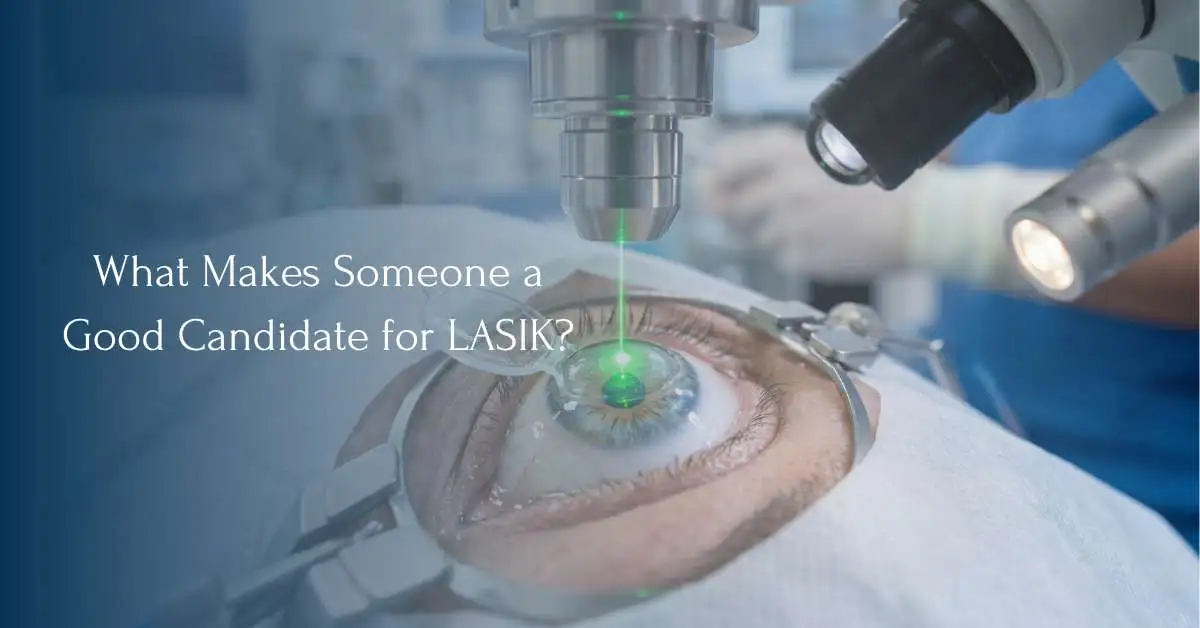
Laser eye surgery has become one of the most common elective procedures in the world, and for the right person it can be quietly life changing. Yet the most important question is rarely about the laser itself. It is about whether your eyes are suited to the treatment in the first place. A careful answer to that question is what keeps LASIK both safe and successful, and a responsible surgeon is just as willing to say no as to say yes.
What LASIK does, in brief
LASIK gently reshapes the cornea, the clear front window of the eye, so that light focuses correctly on the retina at the back. It can correct short sight, long sight and astigmatism, reducing or removing the need for glasses or contact lenses.
A thin protective layer, known as a flap, is created on the surface, the tissue beneath is reshaped by a cool beam of light, and the flap is laid back into place, where it settles without the need for stitches. The procedure itself is quick. The decision about suitability, however, is made well before anyone reaches the laser.
A settled prescription and the right stage of life
One of the first things that matters is stability. LASIK is not usually offered to anyone under eighteen, and many surgeons prefer to wait until the early twenties, because eyes often continue to change before then.
Your glasses or contact lens prescription should have stayed more or less the same for at least a year, and preferably longer. If your vision is still drifting, treating it now simply means correcting a moving target, and the result may not hold. This is exactly why a record of your past prescriptions is so useful at the assessment stage.
Healthy corneas come first
Because LASIK works by reshaping the cornea, the health and shape of that tissue sits at the centre of everything. The cornea needs to be thick enough to allow a safe amount of reshaping while leaving a strong, stable layer behind. It also needs a regular, even surface. Of particular importance is checking that there is no sign of keratoconus, a condition in which the cornea is naturally weak and bulges slowly into a cone. Treating an eye that is already prone to this can weaken the cornea further, so detailed scanning of the corneal surface is an essential part of the work-up. If the cornea is too thin, or its shape is borderline, LASIK is best avoided. That decision protects your sight rather than limiting it.
Your tear film and general health
The surface of the eye is kept clear and comfortable by a fine layer of tears. LASIK can reduce tear production for a time, so anyone who already has a significant dry eye may notice their symptoms worsen. Mild dryness can often be treated before surgery, but severe dry eye is a genuine reason for caution. General health plays a part as well. Conditions that affect healing, such as poorly controlled diabetes or certain autoimmune diseases, can make the outcome less predictable. Pregnancy and breastfeeding can shift the prescription temporarily, so it is sensible to wait until afterwards. None of this is about creating barriers. It is about making sure the eye can heal well and keep its new shape.
Having realistic expectations
A good candidate also understands what LASIK can and cannot do. Most suitable patients achieve excellent unaided vision, comfortably enough to drive and read without glasses, and satisfaction levels recorded in large international reviews are consistently high. Honesty still matters, though. Some people notice dryness, glare or halos around lights in the first weeks or months, and for the great majority these gradually settle as the eye heals. A small number need a second, fine-tuning treatment. Just as importantly, LASIK does not pause the natural aging of the focusing lens inside the eye. This change, called presbyopia, affects everyone from around the mid forties, so even after a successful procedure most people will eventually need reading glasses for close work. Knowing this in advance prevents disappointment later on.
When LASIK is not the answer
Being told that LASIK is not right for you is not the end of the road. Surface based laser treatments such as PRK or LASEK can suit thinner corneas, because they do not involve creating a flap.
SMILE is a newer, keyhole style laser option that works well for certain prescriptions. For very strong prescriptions, or where the cornea is simply unsuitable, an implantable lens placed inside the eye can sometimes give a safer and more stable result. The purpose of a thorough assessment is not only to approve LASIK, but to find the treatment, if any, that genuinely fits your eyes.
How suitability is assessed
All of this comes together in a detailed consultation. Your prescription history is reviewed, the cornea is scanned and measured, the tear film is checked, and your general health and expectations are discussed openly. Contact lens wearers are usually asked to leave their lenses out for a short period beforehand, since lenses can subtly alter the shape of the cornea and affect the readings. The aim is a clear, individual answer rather than a standard one.
References
- The Royal College of Ophthalmologists. Professional standards for refractive surgery. London: RCOphth; 2024. Available at: https://www.rcophth.ac.uk/resources-listing/professional-standards-for-refractive-surgery/
- National Health Service. Laser eye surgery and lens surgery. London: NHS; 2023. Available at: https://www.nhs.uk/conditions/laser-eye-surgery-and-lens-surgery/
- National Institute for Health and Care Excellence. Photorefractive (laser) surgery for the correction of refractive errors. Interventional procedures guidance IPG164. London: NICE; 2006. Available at: https://www.nice.org.uk/guidance/ipg164
- Sandoval HP, Donnenfeld ED, Kohnen T, Lindstrom RL, Potvin R, Tremblay DM, et al. Modern laser in situ keratomileusis outcomes. Journal of Cataract and Refractive Surgery. 2016;42(8):1224–1234.
- Solomon KD, Fernández de Castro LE, Sandoval HP, Biber JM, Groat B, Neff KD, et al. LASIK world literature review: quality of life and patient satisfaction. Ophthalmology. 2009;116(4):691–701.
- American Academy of Ophthalmology. LASIK – laser eye surgery. San Francisco: AAO; 2024. Available at: https://www.aao.org/eye-health/treatments/lasik
