
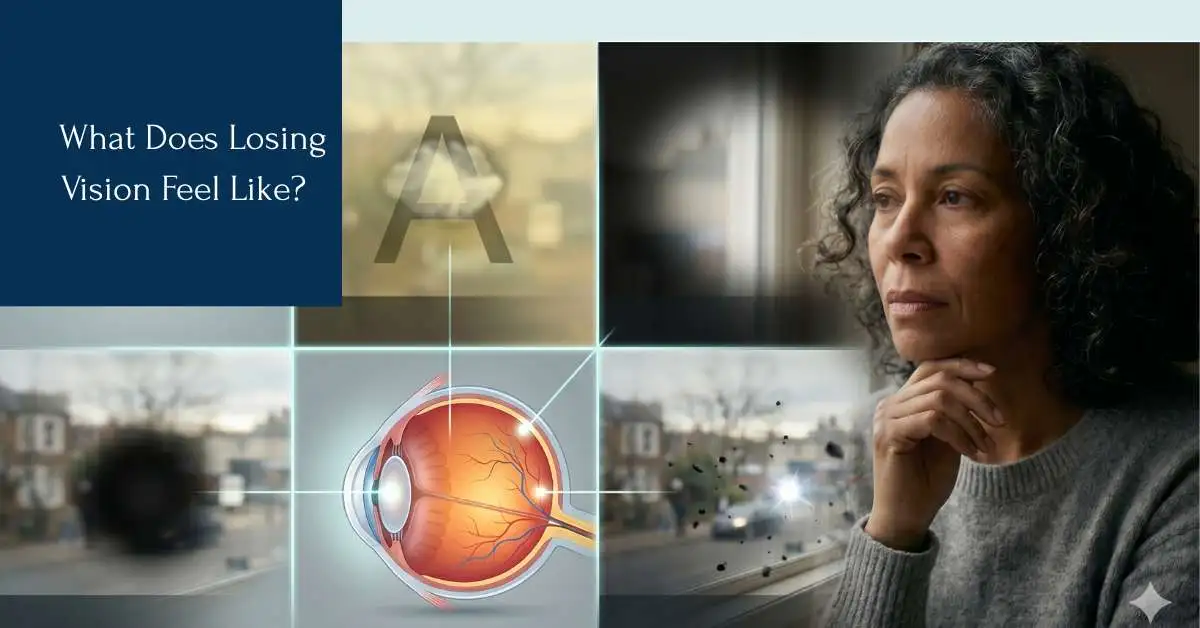
When people imagine losing their sight, they often picture a sudden darkness, as if a light has been switched off. For most eye conditions, the reality is far quieter and slower. Vision usually changes in small steps, and the way it changes depends on which part of the eye is affected. Understanding what these changes feel like can take away some of the fear, and help you notice a problem early, when treatment often works best.
Why we often do not notice at first
A surprising thing about sight loss is how easy it can be to miss. The eye sends signals to the brain, and the brain is very good at filling in areas where it is not receiving clear information.When a small blind patch appears, the brain quietly paints over it using the patterns around it.
Many people only realise something is wrong when an object seems to vanish - a word on a page, a step on the stairs, or a car at a junction. Having two eyes also hides the problem, because one eye can cover for the gaps in the other.
Losing vision from the edges
Some conditions take sight from the outer edges first. Glaucoma is the most common example. It slowly damages the optic nerve, the cable that carries pictures from the eye to the brain. The earliest losses are usually at the sides, and because the centre stays sharp, you can still read and recognise faces for a long time.
Over time the field of view narrows, an effect sometimes called tunnel vision, as if you are looking down a tube.2 This is why glaucoma often causes no obvious symptoms in its early stages.1 People may bump into door frames or miss things coming from the side before they notice any blur. Because the changes are so gentle that the brain hides them, regular eye tests are the most reliable way to pick glaucoma up early.3
Losing vision from the centre
Other conditions affect the middle of vision instead. Age-related macular degeneration, or AMD, damages the macula - the small central part of the retina that gives us our sharpest, most detailed sight. Here the experience feels different. Straight lines, such as a door frame or lines of text, can begin to look bent or wavy. The middle of what you are looking at may turn blurred or smudged while the edges stay clear, a little like a clock face where you can see the rim but not the numbers. Colours can look faded, and reading becomes tiring because letters seem to drop out of words.4
A cloudy or misty view
A cataract feels different again. The lens inside the eye, which is normally clear, slowly becomes cloudy. The world can look misty or hazy, as though you are looking through a steamed-up or dirty window. Colours may seem faded or slightly yellow, bright lights can dazzle, and you may need more light than before to read or cook. Reassuringly, a cataract is treatable. Surgery removes the cloudy lens and replaces it with a clear artificial one, and sight usually returns close to how it was before, as long as the rest of the eye is healthy.
When the change is sudden
Most sight loss is slow, but sometimes it happens quickly, and that is treated very differently. A dark shadow or curtain moving across your vision, a sudden burst of floaters or flashing lights, or a sudden loss of sight in one eye should always be treated as an emergency. These can be signs of a retinal detachment or a problem with the eye's blood supply, where acting fast can save sight. If this happens, do not wait to see if it improves. Go to your nearest eye casualty unit or A&E straight away.
Seeing things that are not there
One experience often catches people off guard. After losing sight, some people begin to see things that are not really there: patterns, shapes, faces, or whole scenes. This is called Charles Bonnet syndrome.9 It can be unsettling, but it is important to know that it is not a sign of a mental health problem or of losing your mind. It happens when the brain, missing its usual stream of pictures, starts to create its own. The images are silent, and most people know they are not real. They often become less frequent with time, and simply telling your eye specialist or GP can bring real reassurance.
The feelings that come with it
Noticing your sight change can be frightening. Worries about independence, driving, or going blind are natural, and they deserve to be taken seriously. Across the UK, around two million people live with some degree of sight loss, so these feelings are far from rare. Understanding what is happening is often the first real step towards feeling calmer and more in control.
When to seek help
You do not need to wait for vision to become poor before asking for advice. Book a routine eye test if you notice gradual blurring, faded colours, more difficulty seeing at night, or that you are bumping into things. Seek urgent care for any sudden change: a curtain or shadow, flashing lights, a shower of new floaters, or sudden loss of sight in one eye. Most eye conditions are easier to manage when they are found early.
A Reassuring Final Thought
Losing vision rarely feels like a switch being flipped. More often it is a slow, quiet shift that the brain works hard to disguise. Knowing the patterns: fading at the edges, blurring or bending in the centre, a misty haze, or a sudden shadow, helps you understand your eyes and act in time. If something feels different about your sight, it is always worth having it checked. Clear answers, given early, are among the most reassuring things in eye care.
References
- National Health Service. Glaucoma. London: NHS; 2021. Available at: https://www.nhs.uk/conditions/glaucoma/
- Jonas JB, Aung T, Bourne RR, Bron AM, Ritch R, Panda-Jonas S. Glaucoma. The Lancet. 2017;390(10108):2183–2193.
- National Institute for Health and Care Excellence. Glaucoma: diagnosis and management. NICE guideline NG81. London: NICE; 2017 (updated 2022). Available at: https://www.nice.org.uk/guidance/ng81
- National Health Service. Age-related macular degeneration (AMD). London: NHS; 2024. Available at: https://www.nhs.uk/conditions/age-related-macular-degeneration-amd/
- Royal National Institute of Blind People. Age-related macular degeneration (AMD). London: RNIB; 2024. Available at: https://www.rnib.org.uk/your-eyes/eye-conditions-az/age-related-macular-degeneration-amd/
- National Health Service. Cataracts. London: NHS; 2023. Available at: https://www.nhs.uk/conditions/cataracts/
- National Health Service. Cataract surgery. London: NHS; 2023. Available at: https://www.nhs.uk/conditions/cataract-surgery/
- National Health Service. Detached retina (retinal detachment). London: NHS; 2024. Available at: https://www.nhs.uk/conditions/detached-retina-retinal-detachment/
- Royal National Institute of Blind People. Charles Bonnet syndrome. London: RNIB; 2024. Available at: https://www.rnib.org.uk/your-eyes/eye-conditions-az/charles-bonnet-syndrome/
- National Health Service. Charles Bonnet syndrome. London: NHS; 2022. Available at: https://www.nhs.uk/conditions/charles-bonnet-syndrome/
- Royal National Institute of Blind People. Key information and statistics on sight loss in the UK. London: RNIB; 2024. Available at: https://www.rnib.org.uk/professionals/research-and-data/key-information-and-statistics-on-sight-loss-in-the-uk/
