
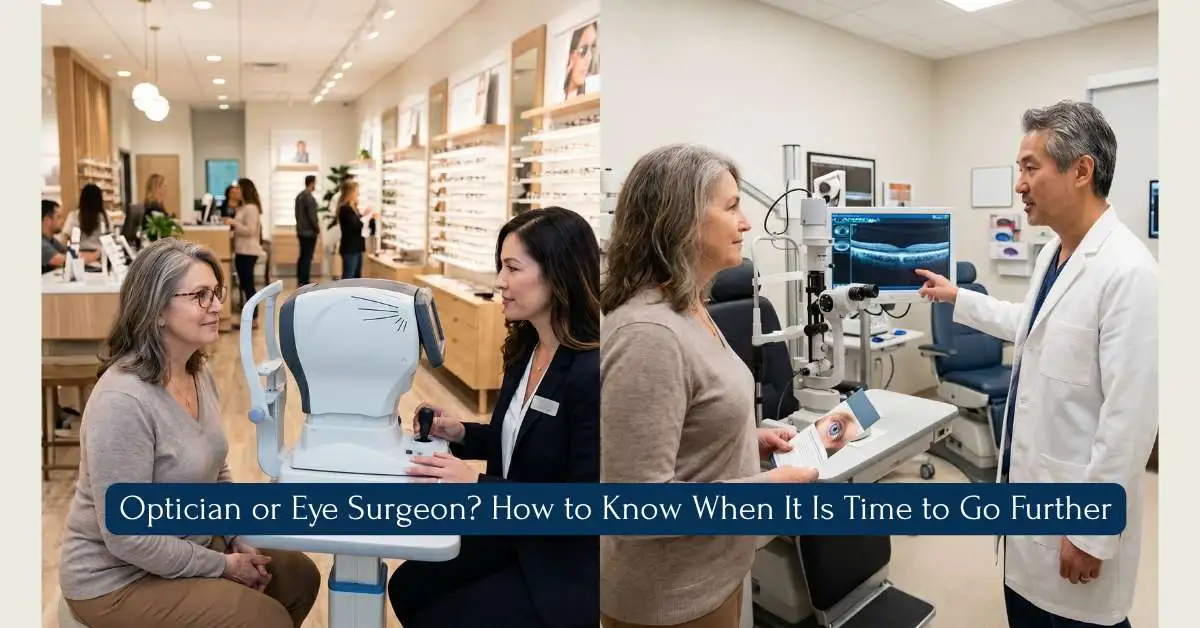
When your sight changes, the optician is usually the right first stop. They check your vision, update your glasses, and watch for early disease. But they cannot run the scans that confirm a diagnosis, prescribe the medicines that slow some eye diseases, or carry out surgery.
That gap matters most with a cataract, macular degeneration, keratoconus, corneal diseases, ocular surface diseases or a sight problem glasses cannot fix.
What Your Optician Can and Cannot Do
You usually meet two high-street experts. An optometrist gives the eye test, checks your eye health, and refers you on if something looks wrong. A dispensing optician fits and supplies glasses or contact lenses. Neither does surgery, eye injections, or treatment of worsening disease. That belongs to an ophthalmologist, a medically qualified eye doctor and surgeon. Cataract, age-related macular degeneration (AMD) and keratoconus can feel like a glasses problem at first, but they need specialist scans and care.
Cataracts: What the Cloudiness Really Is
A cataract is a clouding of the eye's natural lens, which sits behind the coloured iris and focuses light. With age, the proteins inside it clump together and it turns cloudy, so colours look duller, lights dazzle, and vision blurs in a way new glasses cannot fix. A cataract does not damage the back of the eye. Once the cloudy lens is removed and replaced with a clear implant, your sight returns to whatever level the rest of the eye allows, which is why a good check also examines the retina.
Cataract surgery is the most common planned NHS operation, and it is very safe. The main complication happens in fewer than 1 in 100 operations, fewer than 1 in 200 people end up worse than before, and about 95 in 100 eyes with no other disease reach good vision. The NHS operates once it affects your sight enough; going privately buys choice over timing and lens type.
Glasses, Laser or a New Lens: Which Route Fits
For a cataract or a strong prescription, there are three broad routes, each with trade-offs.
Refractive lens exchange is the same operation done before a cataract forms, to reduce reliance on reading glasses, with the same small risks. Recovery is similar, with vision settling over a few weeks and swimming avoided for about a week.
Macular Degeneration: When Days Matter
Age-related macular degeneration is the leading cause of permanent sight loss in older UK adults. It affects the macula, the central part of the retina used for reading, faces and driving. Dry AMD builds up slowly, with no cure, though some vitamin formulas can slow it. In wet AMD, fragile new vessels grow under the macula and leak, and sight can drop fast.
Wet AMD is treated with an eye injection that calms those vessels, holding or improving vision in around 9 in 10 eyes when started early. Opticians cannot give these injections. If you are over 50 and see bent lines, a missing word in the middle of a sentence, or a grey central patch, ask for an urgent assessment, not a routine one.
Keratoconus: A Diagnosis That Often Comes Late
In keratoconus, the cornea, the clear front window of the eye, slowly thins and bulges into a cone shape. It usually starts in the teens or twenties and early on looks like ordinary astigmatism or a changing prescription, so people may go through several pairs of glasses before the cause is found.
The one treatment shown to stop it worsening is corneal cross-linking: vitamin B2 drops on the cornea, then ultraviolet light to stiffen it. It cannot reverse damage already done, so earlier treatment saves more sight. At UHCW, Mr Rana set up and grew the regional cross-linking service, including a programme for children, who can progress fastest.
Dry Eye: Common, and Often Treated Too Simply
Dry eye is often waved off as a minor problem fixed with any drops. In moderate to severe forms it is neither, because the right treatment depends on the cause. In one pattern the eye makes too few tears; in the other, more common one, tears dry up too fast because the tiny oil glands along the eyelids are blocked, so watery drops alone leave the cause untouched.
Treatment builds up step by step: preservative-free drops, warm compresses and eyelid cleaning, omega-3 in the diet, and prescription drops where needed. At UHCW, Mr Rana set up a nurse-led dry eye service. If you have been told to use drops indefinitely without anyone identifying which type you have, a reassessment is reasonable.
Getting the Most From a Specialist Appointment
A little preparation helps. Bring your optician's latest findings in writing, including your prescription and any notes on eye pressure, the retina or the cornea. Note how long symptoms have lasted and what they are like, since slow over months differs from sudden over days.
It is fair to ask:
- Does the surgeon hold a subspecialty qualification in cataract, cornea or retina?
- Will the surgeon who assesses you also operate? In Mr Rana's private clinics, they are the same person.
- Is the check thorough? A cataract assessment without scans of the macula, eye measurements and corneal mapping cannot fully judge risk or choose the best lens.
- Is the surgeon open about what they do not treat, and about the NHS option?
References
- National Institute for Health and Care Excellence. Cataracts in adults: management. NICE guideline NG77. London: NICE; 2017.
- The Royal College of Ophthalmologists. National Ophthalmology Database Audit: Cataract Surgery Annual Report. London: RCOphth; 2023.
- Sparrow JM, Taylor H, Qureshi K, et al. The Royal College of Ophthalmologists' National Ophthalmology Database study of cataract surgery: report 1, visual outcomes and complications. Eye (Lond). 2015;29(4):552-560.
- General Optical Council. Standards of Practice for Optometrists and Dispensing Opticians. London: GOC; 2016.
- National Institute for Health and Care Excellence. Age-related macular degeneration. NICE guideline NG82. London: NICE; 2018.
- Rosenfeld PJ, Brown DM, Heier JS, et al. Ranibizumab for neovascular age-related macular degeneration. N Engl J Med. 2006;355(14):1419-1431.
- Rofagha S, Bhisitkul RB, Boyer DS, et al. Seven-year outcomes in ranibizumab-treated patients in ANCHOR, MARINA and HORIZON (SEVEN-UP study). Ophthalmology. 2013;120(11):2292-2299.
- Wittig-Silva C, Chan E, Islam FMA, et al. A randomized, controlled trial of corneal collagen cross-linking in progressive keratoconus: three-year results. Ophthalmology. 2014;121(4):812-821.
- National Institute for Health and Care Excellence. Photochemical corneal collagen cross-linkage using riboflavin and ultraviolet A for keratoconus and keratectasia. NICE interventional procedures guidance IPG608. London: NICE; 2018.
- Tear Film and Ocular Surface Society. TFOS DEWS III Executive Summary. American Journal of Ophthalmology. 2026;282:135-145.
