
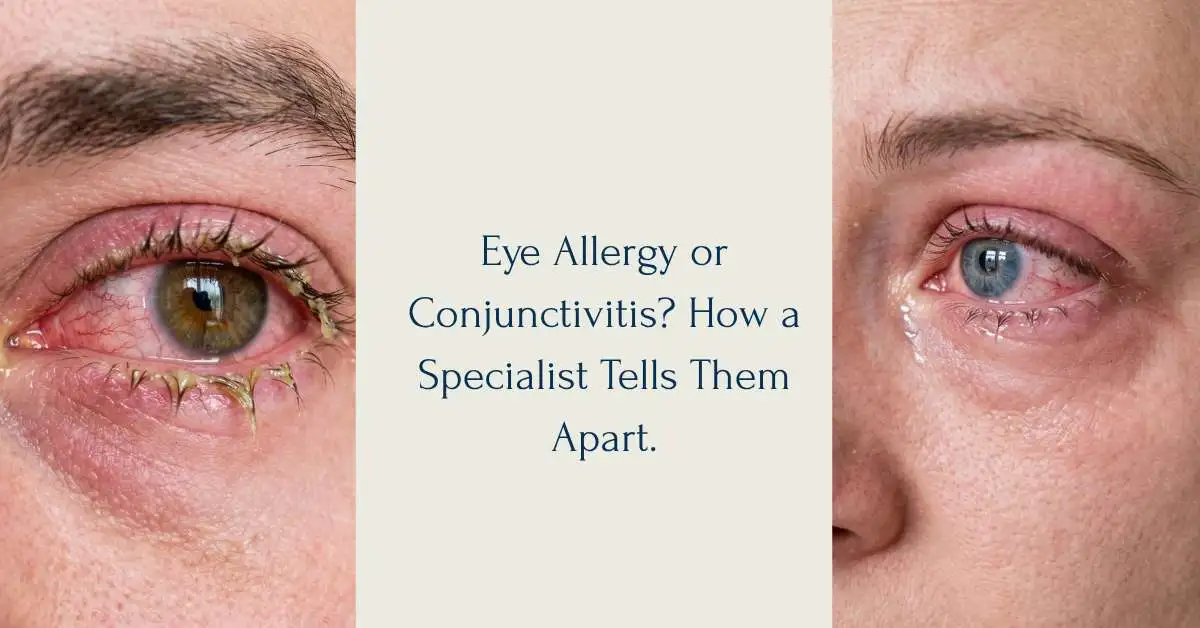
Eye Allergy or Conjunctivitis? How a Specialist Tells Them Apart
Two patients sit in the same waiting room with almost identical symptoms. Both have red, itchy, watery eyes. One assumes it is an allergy. The other assumes it is conjunctivitis because their child had it recently. Both have started treatment based on those assumptions. Neither is improving.
The problem is simple: the treatment was not matched to the actual diagnosis. In eye care, this happens more often than most people realise, and it reliably prolongs symptoms and delays recovery.
What Do These Terms Actually Mean?
Conjunctivitis means inflammation of the conjunctiva, the thin clear layer that lines the inside of the eyelids and covers the white of the eye. It describes where the inflammation is, not what caused it. Allergic, viral, and bacterial conjunctivitis are all different causes of the same location of inflammation.
When a clinician specifies the type, they are identifying what is driving that inflammation. Each cause responds to a different treatment, which is exactly why the cause matters.
Allergic eye disease is triggered by a reaction to something in the environment, such as pollen or dust. It is not caused by a germ and cannot be passed on. It is a subset of the border term Conjunctivitis. Other causes like Infective conjunctivitis, whether bacterial or viral, involve a germ on the surface of the eye and can spread through contact.
How Each Type Works Differently
In allergic conjunctivitis, specialised cells in the eye called mast cells react to a trigger, such as grass or tree pollen, dust or animal dander. They release chemicals ( known as Histamine) that cause itching, redness, and watering almost immediately. There is no infection and no organism to treat.
In bacterial conjunctivitis, bacteria settle on the eye surface and produce thick discharge as the body responds. In viral conjunctivitis, most often caused by adenovirus, the eye becomes watery and highly contagious, often following a cold. The cold-sore virus (herpes simplex) is a less common but more serious cause that requires antiviral treatment and specialist care.
The treatment target in allergy is the allergic reaction itself. In infection, the target is the germ or the inflammation it causes. These two targets share no effective treatments.
Signs That Point to Eye Allergy
Intense itching in both eyes at the same time is the most reliable sign of allergic eye disease. People describe a strong urge to rub both eyes. Rubbing feels like relief for a moment but quickly makes the redness and swelling worse.
Discharge in allergy is clear and watery, not sticky. Both eyes are affected at once and the redness appears as a spread-out pink. Symptoms usually have a clear link to a particular season, environment, or animal contact. Seasonal symptoms during the UK grass pollen season, roughly May to July, are a hallmark of seasonal allergic conjunctivitis. A runny nose, sneezing, or itchy nose alongside eye symptoms makes an allergic cause considerably more likely.
Signs That Point to Infective Conjunctivitis
Thick yellow or green discharge that makes eyelids stick together after sleep is typical of bacterial conjunctivitis. The redness tends to be stronger, and the main feeling is gritty irritation rather than itch. It often starts in one eye before spreading to the other.
Viral conjunctivitis from adenovirus produces watery discharge, which can look like an allergy. The key differences are context: it usually follows a cold, spreads after contact with someone affected, and may cause a tender swollen lymph node in front of the ear. This sign does not appear in allergy.
Heavy crusting around the eyelids on waking is more common in bacterial infection. When both eyelids are stuck shut and difficult to open, bacterial conjunctivitis is the more likely cause.
Why Getting It Wrong Matters
The overlap between viral conjunctivitis and seasonal allergy is enough to make self-diagnosis unreliable in a fair number of cases. Both can worsen in spring. Both affect both eyes. Both cause watery discharge and redness.
The consequences of a wrong diagnosis are real. Antibiotic drops are ineffective for allergy or viral infection and contribute to antibiotic resistance. Antihistamine drops do nothing for a bacterial infection. If a cold-sore-virus infection is mistaken for allergy and antiviral treatment is delayed, the virus can damage the cornea and cause recurrent scarring.
Research has shown that even clinicians find it difficult to distinguish bacterial from viral conjunctivitis by appearance alone. Self-diagnosis, without a slit-lamp examination or careful clinical history, carries a higher error rate still.
When to Stop Self-Treating and See a Specialist
Symptoms that persist beyond five to seven days without improvement suggest the treatment is not right for the condition. Most bacterial conjunctivitis responds to the correct antibiotic within five days. Allergic conjunctivitis usually responds to antihistamine drops within about 48 hours.
Seek prompt specialist review if you notice any of the following:
- Pain inside the eye, not just surface grittiness
- Sensitivity to light alongside redness or itching
- Blurred or fluctuating vision
- Symptoms returning repeatedly without fully clearing
These features point to a deeper problem that needs expert assessment.
What a Specialist Assessment Involves
A structured history comes first: when symptoms began, their pattern, the type of discharge, whether one or both eyes are affected, any allergen exposures, and any previous eye conditions.
Slit-lamp examination of the eye surface and inner eyelid identifies the tissue response that separates allergic from infective conjunctivitis. Certain patterns visible only under magnification reliably distinguish an allergic from a viral or bacterial cause. A dye placed on the cornea reveals any surface damage, including the branching pattern of cold-sore-virus keratitis, which must be ruled out before any steroid treatment is used. Where the diagnosis remains uncertain, laboratory swabs provide confirmation.
References
- Wilhelmus KR, 'Antiviral treatment and other therapeutic interventions for herpes simplex virus epithelial keratitis', Cochrane Database of Systematic Reviews, Issue 1, 2015, CD002898.
- Scadding GK, Kariyawasam HH, Scadding G, et al., 'BSACI guideline for the diagnosis and management of allergic and non-allergic rhinitis', Clinical and Experimental Allergy, 47(7), 2017, pp. 856-889.
- Sheikh A, Hurwitz B, van Schayck CP, et al., 'Antibiotics versus placebo for acute bacterial conjunctivitis', Cochrane Database of Systematic Reviews, Issue 9, 2012, CD001211.
- Azari AA and Barney NP, 'Conjunctivitis: a systematic review of diagnosis and treatment', JAMA, 310(16), 2013, pp. 1721-1729.
- Leonardi A, Doan S, Fauquert JL, et al., 'Diagnostic tools and clinical management of vernal keratoconjunctivitis', British Journal of Ophthalmology, 96(8), 2012, pp. 1101-1108.
- National Institute for Health and Care Excellence (NICE), Conjunctivitis - Allergic: Clinical Knowledge Summary, NICE, London, available at: cks.nice.org.uk [accessed May 2026].
- National Institute for Health and Care Excellence (NICE), Conjunctivitis - Infective: Clinical Knowledge Summary, NICE, London, available at: cks.nice.org.uk [accessed May 2026].
- General Medical Council, Good Medical Practice, GMC, London, 2024, available at: gmc-uk.org [accessed May 2026].
