
Most of us now spend hours each day looking at screens, so it is natural to worry that all this time online might be quietly harming our eyes. It is one of the questions I am asked most often, by adults tired at the end of a working day and by parents anxious about their children. The honest answer is reassuring.
For adults, screens cause real discomfort but not lasting damage. In children, there is one genuine long-term concern worth understanding, and it is one we can do something about.
What screens actually do to your eyes
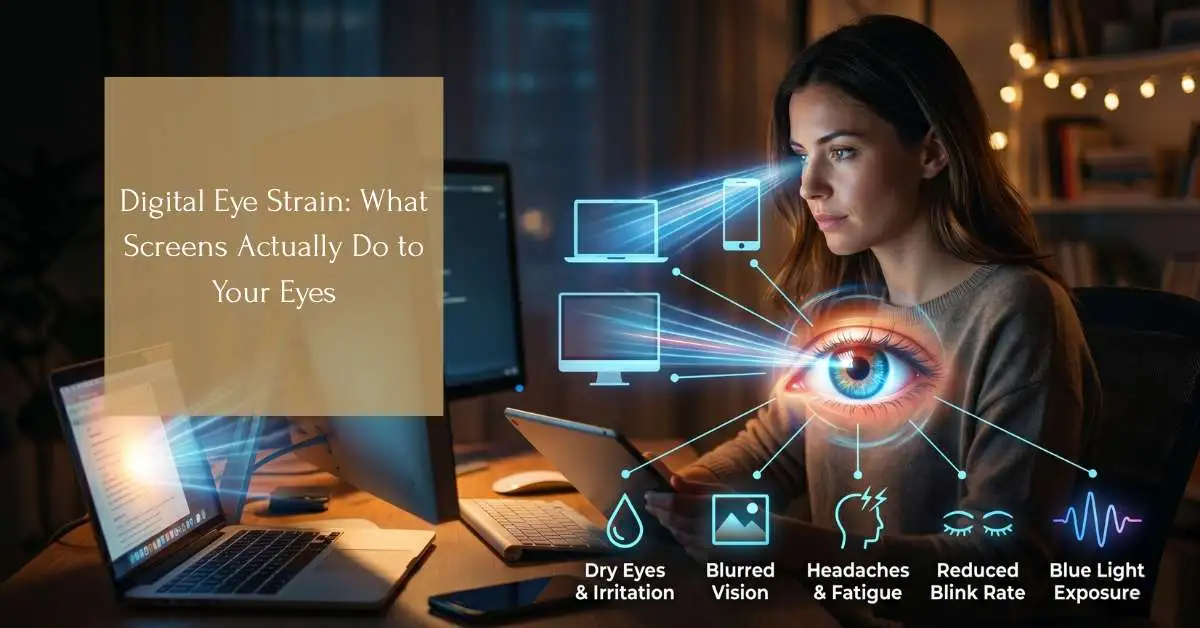
The tiredness, blurring and aching that many people feel after a long stretch at a screen has a name: digital eye strain, sometimes called computer fatigue syndrome. It is extremely common, but it is important to understand what it is and what it is not. It is a problem of overworked focusing muscles and a dried-out surface, not injury to the inside of the eye. When you concentrate on a screen, your eyes hold a close focus for long periods, which tires the small muscles that adjust your focusing.
Small text, glare and reflections make them work harder still. Perhaps most importantly, people blink far less when staring at a screen, sometimes around half as often as usual, so the tear film that keeps the eye smooth and comfortable evaporates and the surface becomes dry and gritty. The result is sore, tired eyes and blurring, but these symptoms are temporary and ease with rest.
Putting the blue light worry in proportion
Much has been written about blue light, the high-energy light that screens give off, and it is often blamed for eye damage. Here the evidence is genuinely reassuring. The amount of blue light coming from phones, tablets and computers is small, far less than we receive naturally from daylight, and there is no good evidence that it damages the eye at the levels screens produce. Blue light can, however, affect sleep if you use bright screens late in the evening, because it influences the body clock.
This is a reason to wind down screens before bed, not a reason to fear for your sight. Blue-light filtering glasses are widely sold, but current evidence does not show that they protect the eyes or reduce strain, so they are not something I routinely recommend for that purpose.
The one real long-term concern: children and short-sightedness
Where screens deserve more serious attention is in childhood. Across the world, and in the UK, short-sightedness, known medically as myopia, is becoming far more common, and the proportion of myopic children has roughly doubled over the past fifty years. Myopia is where distant objects look blurred because the eye grows slightly too long. It tends to begin and progress during the school years. Genetics play a large part, but lifestyle matters too.
Long hours of close work, including time on phones and tablets, and a lack of time spent outdoors are both linked to children becoming short-sighted earlier and more strongly. This matters beyond needing glasses, because higher levels of myopia carry a greater risk of eye problems in later life. The encouraging news is that the single most protective habit is simple and free: regular time outdoors in daylight, ideally around two hours a day, appears to help protect a child's developing eyes.
Sensible habits that genuinely help
For adults, the aim is comfort, and a few small changes make a real difference. A helpful guide is the twenty, twenty, twenty rule: every twenty minutes, look at something around twenty feet away for about twenty seconds, which lets the focusing muscles relax. Position the screen a little below eye level and at arm's length, reduce glare from windows and lights, and make a conscious effort to blink fully. Lubricating drops, often called artificial tears, can be very soothing if your eyes feel dry, and taking proper breaks matters more than any gadget.
For children, balance is the key principle: sensible limits on recreational screen time, frequent breaks during homework, and plenty of active time outdoors. None of this requires special glasses or expensive equipment, simply steady, everyday habits.
When screen discomfort is really something else
It is worth knowing that persistent screen-related symptoms sometimes point to a treatable problem that has little to do with the screen itself. An out-of-date or uncorrected glasses prescription is a common culprit, as the eyes tire quickly when they are straining to focus.
Underlying dry eye disease, which becomes more common with age and in certain conditions, can be unmasked by screen use. Occasionally, symptoms blamed on screens turn out to have another cause entirely. This is why lasting discomfort is worth checking rather than simply enduring.
References
- Sheppard AL, Wolffsohn JS. Digital eye strain: prevalence, measurement and amelioration. BMJ Open Ophthalmology. 2018;3(1):e000146.
- College of Optometrists. The effect of digital devices on the eyes: guidance and patient information. London: College of Optometrists; 2024. Available at: https://www.college-optometrists.org
- American Academy of Ophthalmology. Computers, digital devices and eye strain; blue light and your eyes. San Francisco: AAO; 2024. Available at: https://www.aao.org/eye-health/tips-prevention/computer-usage
- Lawrenson JG, Hull CC, Downie LE. The effect of blue-light blocking spectacle lenses on visual performance, macular health and the sleep-wake cycle: a systematic review. Ophthalmic and Physiological Optics. 2017;37(6):644–654.
- McCullough SJ, O'Donoghue L, Saunders KJ. Six year refractive change among white children and young adults: evidence for significant increase in myopia among white UK children (NICER Study). PLOS ONE. 2016;11(1):e0146332.
- Royal College of Paediatrics and Child Health. The health impacts of screen time: guidance for clinicians and parents. London: RCPCH; 2019. Available at: https://www.rcpch.ac.uk/resources/health-impacts-screen-time-guide-clinicians-parents
