
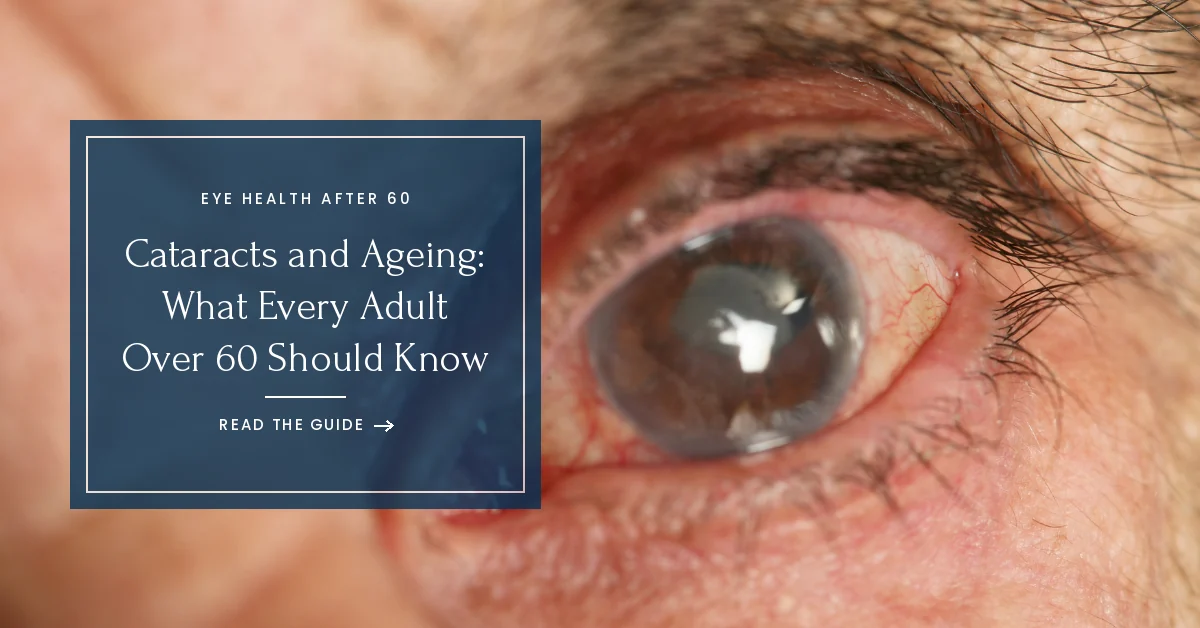
If you live long enough, you will almost certainly develop a cataract. That may sound alarming, but it is one of the most reassuring facts in eye care, because a cataract is a normal part of ageing and, when the time comes, one of the most treatable conditions in all of medicine. Around a third of people over sixty-five in the UK already have some degree of cataract.1 Understanding why it happens, and what can be done, takes away much of the worry that the word can carry.
What a cataract is, and why ageing causes one
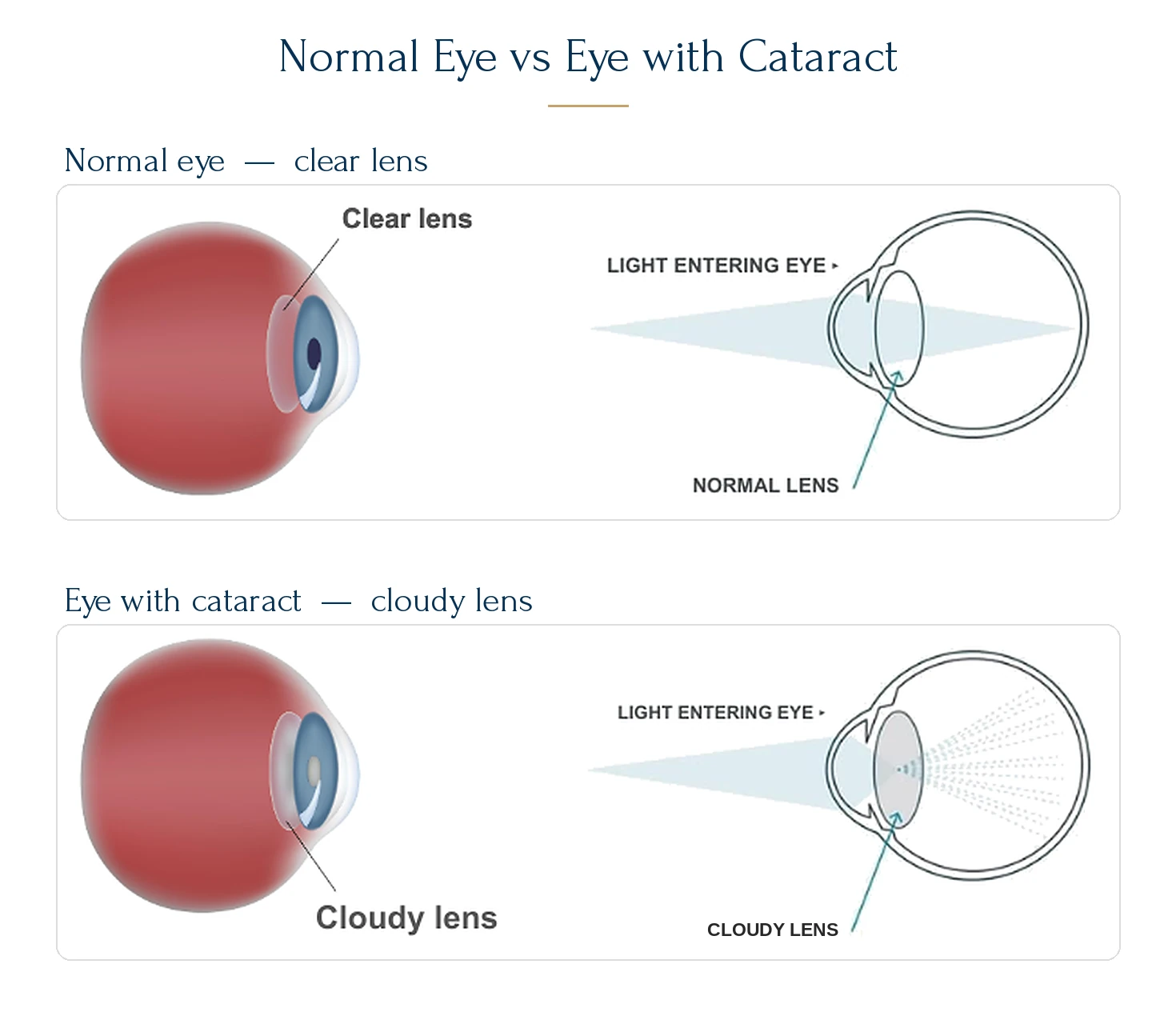
Inside your eye, just behind the coloured iris, sits a small clear lens. It works like the lens of a camera, focusing light to give a sharp picture at the back of the eye. This lens is built mainly from special proteins, called crystallins, arranged so precisely that the lens stays perfectly see-through.2 Here is the key point that explains everything else: these proteins are made before birth and are never replaced during your life. Because they are never renewed, they slowly gather damage over many decades, from natural chemical wear, from a process called oxidation, and from a lifetime of sunlight.2,3 Eventually the damaged proteins begin to clump together. When the clumps grow large enough, they scatter light instead of letting it pass cleanly through, and the lens turns from clear to cloudy. That cloudiness is a cataract. A useful way to picture it is a clear window that very gradually frosts over.3 Seen this way, a cataract is less a disease that strikes and more the slow, expected ageing of a part of the eye that has been working since before you were born.
A condition that affects the whole world
Cataracts are not just common in Britain; they are the leading cause of blindness across the world.4 Globally, of the tens of millions of people who are blind, around fifteen million have lost their sight to cataract.4 What is striking is where that burden falls. In countries like the UK, cataract surgery is routine, safe and widely available, so cataract rarely leads to lasting blindness; it is simply removed when it begins to interfere with life.5 In many lower-income countries, the difficulty is not the cataract itself but reaching surgery, because trained surgeons, equipment and clinics are scarce. The same straightforward operation that restores sight in a single morning here can remain out of reach for years elsewhere. It is a powerful reminder that cataract blindness is almost entirely avoidable when care can be reached.
When it develops, and what can speed it up
Age is by far the biggest factor, and changes in the lens often begin quietly from the forties onwards, long before anyone notices a problem. Most cataracts that affect vision appear from the sixties and beyond.1 Some things can bring them on earlier or make them progress faster. Diabetes is an important one, as higher blood sugar speeds up changes in the lens.6 Smoking and heavy alcohol use, years of strong sunlight without eye protection, long-term use of steroid medicines, and previous eye injury or surgery all raise the risk too.5,7 Not all of these can be changed, but stopping smoking, protecting the eyes from ultraviolet light with good sunglasses, and managing conditions like diabetes are sensible steps for the whole body, not only the eyes.
What you might notice
Cataracts usually develop slowly over months or years, so the changes can be easy to miss at first. Vision may become misty or blurred, as though you are looking through a smeared window. Colours can seem faded or yellowed, bright lights and headlights may dazzle or create haloes, and you may find you need more light to read or that your glasses prescription keeps changing.8 Because both eyes are often affected, though not always equally, the world can simply seem gradually dimmer and less crisp than it once was.
How it is diagnosed and dealt with
A cataract is straightforward to confirm. An optometrist or eye specialist examines the lens using a microscope with a bright light, often after using drops to widen the pupil, and measures how well you see.8 It is worth being clear about treatment, because there is a lot of misinformation. No eye drop, tablet, diet or exercise has been proven to clear a cataract once it has formed; the only effective treatment is surgery.4 The good news is that this is among the most common and successful operations performed anywhere. In England alone, around 330,000 cataract operations are carried out each year, and it is the most frequently performed planned operation in the NHS.5 During the procedure, which usually takes around twenty minutes under local anaesthetic, the cloudy lens is removed and replaced with a clear artificial one, and most people go home the same day.
Importantly, surgery is not decided by reaching a particular number on a vision chart. It is offered when the cataract is interfering enough with the things you need and want to do, such as driving, reading or hobbies, to make the small risks of surgery worthwhile for you.8
That decision is a shared one, made with your surgeon, and there is rarely any urgency to rush it.
When to seek advice
If your vision is gradually becoming cloudy, dim or harder to manage for daily tasks, it is worth arranging an eye examination, which for most adults is sensible every couple of years in any case. There is no need to wait until sight is poor. You should seek prompt attention for any sudden change in vision, new pain, or flashes and floaters, as these point to other problems rather than a simple cataract. For a gradual, painless blurring, an unhurried assessment is the right and reassuring next step.8
References
- Royal National Institute of Blind People. Cataracts. London: RNIB; 2024. Available at: https://www.rnib.org.uk/your-eyes/eye-conditions-az/cataracts/
- Truscott RJW. Age-related nuclear cataract: oxidation is the key. Experimental Eye Research. 2005;80(5):709–725.
- Moreau KL, King JA. Protein misfolding and aggregation in cataract disease and prospects for prevention. Trends in Molecular Medicine. 2012;18(5):273–282.
- GBD 2019 Blindness and Vision Impairment Collaborators / World Health Organization. World report on vision. Geneva: WHO; 2019. Available at: https://www.who.int/publications/i/item/9789241516570
- Day AC, Donachie PHJ, Sparrow JM, Johnston RL; Royal College of Ophthalmologists. Cataract surgery commissioning guidance and National Ophthalmology Database. London: RCOphth; 2018. Available at: https://www.rcophth.ac.uk/resources-listing/cataract-surgery-commissioning-guidance/
- Becker C, Schneider C, Aballea S, et al. Cataract in patients with diabetes mellitus: incidence rates in the UK and risk factors. Eye (London). 2018;32(6):1028–1035.
- Floud S, Kuper H, Reeves GK, Beral V, Green J. Risk factors for cataracts treated surgically in postmenopausal women. Ophthalmology. 2016;123(8):1704–1710.
- National Institute for Health and Care Excellence. Cataracts in adults: management. NICE guideline NG77. London: NICE; 2017. Available at: https://www.nice.org.uk/guidance/ng77
