
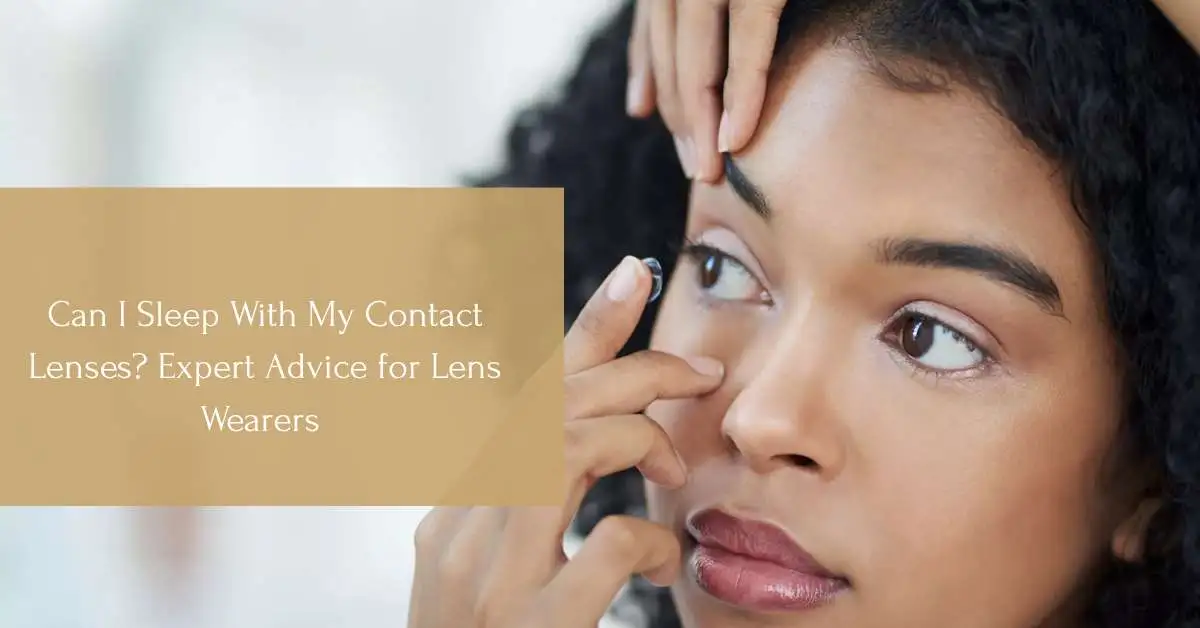
It is one of the most common questions I am asked, often a little sheepishly, by people who have nodded off on the sofa. The honest answer is that, as a general rule, you should not sleep in your contact lenses. This is not strictness for its own sake. Sleeping in lenses is one of the few contact lens habits that genuinely raises the risk of a serious eye infection, and understanding why makes the advice much easier to follow.
Why your eyes do not like it
The cornea is the clear window at the front of the eye, and unlike most of your body it has no blood supply of its own. It takes the oxygen it needs directly from the air, through the tear film that bathes its surface. A contact lens sits on top of the cornea, so it already reduces the oxygen reaching it during the day.
When you close your eyes to sleep, far less oxygen is available anyway, and a lens on a closed eye reduces it further still. The cornea responds by swelling very slightly and becoming more vulnerable. Even modern, highly breathable lens materials do not remove this problem, which is why the advice applies to almost all lenses, not just older ones.
What can actually go wrong
The main concern is a condition called microbial keratitis, which is an infection of the cornea caused by bacteria or, less commonly, by fungi or a waterborne organism. It can develop quickly, is often painful, and in severe forms can scar the cornea and permanently affect vision. Sleeping in lenses, whether on purpose or by accident, increases the risk of this kind of infection by roughly six to eight times compared with removing them at night.
The overall chance in any year stays low for a careful daily wearer, but rises several fold once overnight wear becomes a habit. When an infection does take hold it can be serious and slow to heal, which is what makes prevention so worthwhile.
Naps, extended wear lenses and other grey areas
People often assume the rule does not apply to them for one reason or another. A short nap still counts, because the cornea begins to lose oxygen as soon as the eyes are closed, so an afternoon doze in your lenses carries the same kind of risk in miniature. Lenses sold as suitable for extended or continuous wear are a more nuanced case. They are designed to pass more oxygen and are sometimes approved for overnight use, but they do not abolish the risk, and infections still occur in people using them as directed.
There is a very wrong idea floating in the society that extended wear lenses can be worn on day 1 and then taken out on day 30 . This is sold by local contact lens specialists to attract vulnerable young adults who don't look at the fine print. Sleeping , Showering and swimming in lenses carry a high risk of infections especially protozoal waterborne infections.
The one planned exception
There is a legitimate form of overnight lens wear called orthokeratology, sometimes shortened to ortho-k. These are specially designed rigid lenses worn only at night to gently reshape the cornea, so that vision is clearer during the day without lenses. They are also used in children as one way of slowing the progression of short-sightedness.
Orthokeratology is a recognised treatment, but it is carried out under careful professional supervision, with proper fitting, clear hygiene instructions and regular check-ups, precisely because overnight wear carries added risk. It is very different from sleeping in ordinary daytime lenses, which are not made for the purpose. The risk of problems remains and therefore Ortho-k is losing its charm in the ophthalmic community.
If you do fall asleep in them
Falling asleep in your lenses once is not a reason to panic, and it happens to most wearers. When you wake, do not pull the lens off straight away if it feels stuck and dry, as this can scratch the surface. Instead, blink a few times and use preservative-free lubricating drops to rehydrate the eye until the lens moves freely, then remove it. Give your eyes a rest from lenses for the day if you can, and keep an eye on how they feel. The important thing is to know the warning signs that mean you should be checked rather than wait.
Habits that keep lens wear safe
Most lens wearers enjoy years of trouble-free use by following a few simple habits. Always wash and dry your hands before handling lenses. Keep lenses away from water of every kind, including tap water, showers, swimming pools, the sea and hot tubs, because water can carry an organism that causes a particularly stubborn and sight-threatening infection.
Daily disposable lenses, worn once and discarded, tend to carry a lower risk than reusable lenses. If you use reusable lenses, clean and store them only in the proper solution, never saline or water, and replace both the lenses and the case as advised. Attend your regular contact lens check-ups, since these catch small problems before they become large ones.
References
- Carnt N, Hoffman JM, Verma S, Hau S, Radford CF, Minassian DC, et al. Acanthamoeba keratitis: confirmation of the UK outbreak and a prospective case-control study identifying contributing risk factors. Ophthalmology. 2018 (and related case-control analysis, Ophthalmology, 2023). Summary available at: https://www.ucl.ac.uk/news/2022/sep/reusable-contact-lenses-more-triple-risk-rare-preventable-eye-infection
- Cope JR, Collier SA, Nethercut H, Jones JM, Yates K, Yoder JS. Corneal infections associated with sleeping in contact lenses: six cases, United States, 2016–2018. Morbidity and Mortality Weekly Report (MMWR). 2018;67(32):877–881. Available at: https://www.cdc.gov/mmwr/volumes/67/wr/mm6732a2.htm
- College of Optometrists. Contact lenses for overnight wear: clinical guidance. London: College of Optometrists; 2024. Available at: https://www.college-optometrists.org/clinical-guidance/guidance/knowledge,-skills-and-performance/contact-lenses-for-overnight-wear
- Moorfields Eye Hospital NHS Foundation Trust. Five golden rules for safe contact lens use. London: Moorfields; 2024. Available at: https://www.moorfields.nhs.uk/private/about-moorfields-private/blog-articles/five-golden-rules-for-safe-contact-lens-use
- University Hospitals Coventry and Warwickshire NHS Trust. Information for soft contact lens wearers. Coventry: UHCW NHS Trust; 2023. Available at: https://www.uhcw.nhs.uk
- British Contact Lens Association. Contact lens wearer resources and water exposure guidance. London: BCLA; 2024. Available at: https://www.bcla.org.uk
